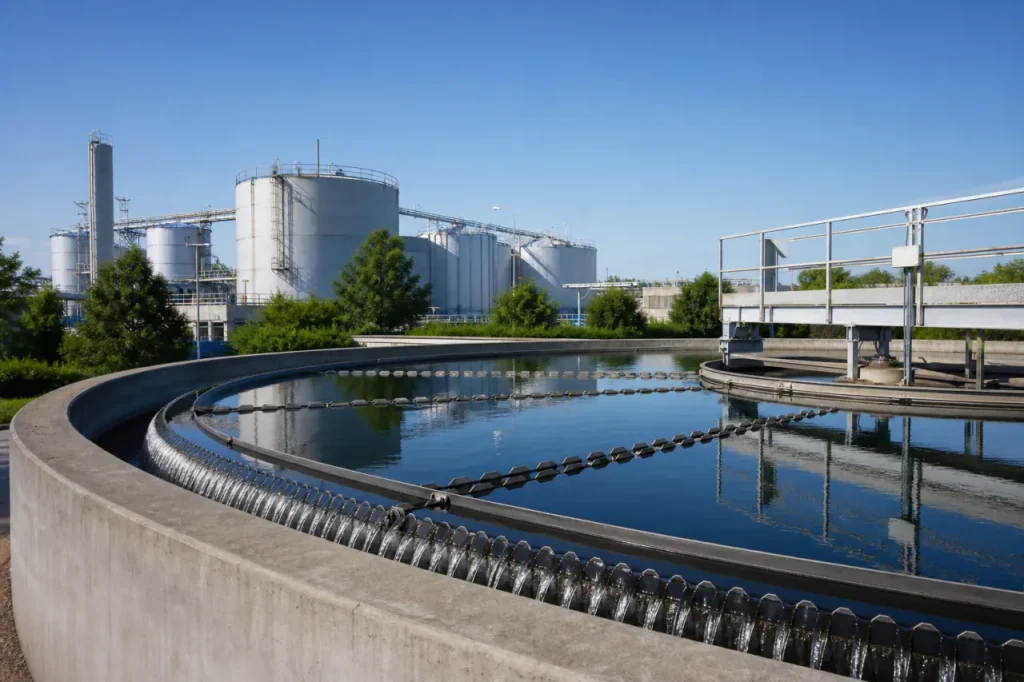
Across industrial basins and expanding urban corridors, water scarcity is no longer a seasonal concern-it’s a permanent operating constraint. For municipal utilities and manufacturing facilities, wastewater recycling transforms an existing discharge into a controlled, high-value supply.
What is Wastewater Recycling?
Wastewater recycling is the engineered process of treating municipal or industrial effluent to safe standards for beneficial reuse, rather than discharging it into the environment. The practice shifts the view of wastewater from a liability to an alternative source that can offset freshwater demand.
Three terms define the water reuse cycle:
- Reclamation: The physical and chemical treatment to upgrade wastewater quality.
- Recycling: Applying reclaimed water back into the same facility or process that generated it.
- Reuse: Sending treated water to a different end user, such as an adjacent plant or municipal irrigation network.
Knowing the difference matters when aligning a treatment train with a permit or a reuse objective.
Defining Reclamation, Recycling, and Reuse
Reclamation is the physical and chemical treatment needed to upgrade wastewater quality. Recycling applies that reclaimed water back into the same facility or process that generated it.
Reuse sends it to a different end user, such as an adjacent manufacturing plant or a municipal landscape irrigation network.
An automotive assembly line treating process water for non-potable applications like parts washing is recycling internally, while a city supplying golf course irrigation from its municipal treatment plant is operating a reuse scheme.
Direct Potable vs. Indirect Potable vs. Non-Potable Reuse
The destination category drives every subsequent engineering choice. Each reuse type follows a distinct pathway:
- Non-potable reuse: Irrigation, cooling tower makeup, toilet flushing.
- Indirect potable reuse (IPR): Environmental buffer-groundwater injection or reservoir blending-before drinking water intake.
- Direct potable reuse (DPR): Highly treated effluent directly piped to the drinking water treatment plant or distribution system.
The treatment rigor rises sharply across these categories. Non-potable applications may settle for tertiary filtration and disinfection. DPR and high-purity IPR require advanced oxidation and multi-barrier reverse osmosis (RO) systems for water reuse to remove trace organics and pathogens at parts-per-trillion levels.
Primary Types and Applications of Recycled Water
Recycled water is categorized by treatment class, not just source. Each class maps to specific end uses. Most regulatory frameworks define quality thresholds for four broad tiers: primary (settled), secondary (biologically treated), tertiary (filtered and disinfected), and advanced (RO-polished).
Matching the treatment class to the application avoids overdesign and keeps capital expense proportionate to risk. The table below aligns typical system outputs with practical deployment scenarios.
| Water Class | Treatment Requirement | cURL Too many subrequests by single Worker invocation. To configure this limit, refer to https://developers.cloudflare.com/workers/wrangler/configuration/#limits |
|---|---|---|
| cURL Too many subrequests by single Worker invocation. To configure this limit, refer to https://developers.cloudflare.com/workers/wrangler/configuration/#limits | cURL Too many subrequests by single Worker invocation. To configure this limit, refer to https://developers.cloudflare.com/workers/wrangler/configuration/#limits | cURL Too many subrequests by single Worker invocation. To configure this limit, refer to https://developers.cloudflare.com/workers/wrangler/configuration/#limits |
| cURL Too many subrequests by single Worker invocation. To configure this limit, refer to https://developers.cloudflare.com/workers/wrangler/configuration/#limits | cURL Too many subrequests by single Worker invocation. To configure this limit, refer to https://developers.cloudflare.com/workers/wrangler/configuration/#limits | cURL Too many subrequests by single Worker invocation. To configure this limit, refer to https://developers.cloudflare.com/workers/wrangler/configuration/#limits |
| cURL Too many subrequests by single Worker invocation. To configure this limit, refer to https://developers.cloudflare.com/workers/wrangler/configuration/#limits | cURL Too many subrequests by single Worker invocation. To configure this limit, refer to https://developers.cloudflare.com/workers/wrangler/configuration/#limits | cURL Too many subrequests by single Worker invocation. To configure this limit, refer to https://developers.cloudflare.com/workers/wrangler/configuration/#limits |
| cURL Too many subrequests by single Worker invocation. To configure this limit, refer to https://developers.cloudflare.com/workers/wrangler/configuration/#limits | cURL Too many subrequests by single Worker invocation. To configure this limit, refer to https://developers.cloudflare.com/workers/wrangler/configuration/#limits | cURL Too many subrequests by single Worker invocation. To configure this limit, refer to https://developers.cloudflare.com/workers/wrangler/configuration/#limits |
cURL Too many subrequests by single Worker invocation. To configure this limit, refer to https://developers.cloudflare.com/workers/wrangler/configuration/#limits.
cURL Too many subrequests by single Worker invocation. To configure this limit, refer to https://developers.cloudflare.com/workers/wrangler/configuration/#limits
- cURL Too many subrequests by single Worker invocation. To configure this limit, refer to https://developers.cloudflare.com/workers/wrangler/configuration/#limits
- cURL Too many subrequests by single Worker invocation. To configure this limit, refer to https://developers.cloudflare.com/workers/wrangler/configuration/#limits
- cURL Too many subrequests by single Worker invocation. To configure this limit, refer to https://developers.cloudflare.com/workers/wrangler/configuration/#limits
cURL Too many subrequests by single Worker invocation. To configure this limit, refer to https://developers.cloudflare.com/workers/wrangler/configuration/#limits
cURL Too many subrequests by single Worker invocation. To configure this limit, refer to https://developers.cloudflare.com/workers/wrangler/configuration/#limits.
cURL Too many subrequests by single Worker invocation. To configure this limit, refer to https://developers.cloudflare.com/workers/wrangler/configuration/#limits.
cURL Too many subrequests by single Worker invocation. To configure this limit, refer to https://developers.cloudflare.com/workers/wrangler/configuration/#limits cURL Too many subrequests by single Worker invocation. To configure this limit, refer to https://developers.cloudflare.com/workers/wrangler/configuration/#limits, cURL Too many subrequests by single Worker invocation. To configure this limit, refer to https://developers.cloudflare.com/workers/wrangler/configuration/#limits.
cURL Too many subrequests by single Worker invocation. To configure this limit, refer to https://developers.cloudflare.com/workers/wrangler/configuration/#limits
cURL Too many subrequests by single Worker invocation. To configure this limit, refer to https://developers.cloudflare.com/workers/wrangler/configuration/#limits.
cURL Too many subrequests by single Worker invocation. To configure this limit, refer to https://developers.cloudflare.com/workers/wrangler/configuration/#limits.
cURL Too many subrequests by single Worker invocation. To configure this limit, refer to https://developers.cloudflare.com/workers/wrangler/configuration/#limits cURL Too many subrequests by single Worker invocation. To configure this limit, refer to https://developers.cloudflare.com/workers/wrangler/configuration/#limits.
cURL Too many subrequests by single Worker invocation. To configure this limit, refer to https://developers.cloudflare.com/workers/wrangler/configuration/#limits.
cURL Too many subrequests by single Worker invocation. To configure this limit, refer to https://developers.cloudflare.com/workers/wrangler/configuration/#limits
cURL Too many subrequests by single Worker invocation. To configure this limit, refer to https://developers.cloudflare.com/workers/wrangler/configuration/#limits.
cURL Too many subrequests by single Worker invocation. To configure this limit, refer to https://developers.cloudflare.com/workers/wrangler/configuration/#limits.
cURL Too many subrequests by single Worker invocation. To configure this limit, refer to https://developers.cloudflare.com/workers/wrangler/configuration/#limits
cURL Too many subrequests by single Worker invocation. To configure this limit, refer to https://developers.cloudflare.com/workers/wrangler/configuration/#limits.
cURL Too many subrequests by single Worker invocation. To configure this limit, refer to https://developers.cloudflare.com/workers/wrangler/configuration/#limits
- cURL Too many subrequests by single Worker invocation. To configure this limit, refer to https://developers.cloudflare.com/workers/wrangler/configuration/#limits cURL Too many subrequests by single Worker invocation. To configure this limit, refer to https://developers.cloudflare.com/workers/wrangler/configuration/#limits
- cURL Too many subrequests by single Worker invocation. To configure this limit, refer to https://developers.cloudflare.com/workers/wrangler/configuration/#limits cURL Too many subrequests by single Worker invocation. To configure this limit, refer to https://developers.cloudflare.com/workers/wrangler/configuration/#limits
- cURL Too many subrequests by single Worker invocation. To configure this limit, refer to https://developers.cloudflare.com/workers/wrangler/configuration/#limits cURL Too many subrequests by single Worker invocation. To configure this limit, refer to https://developers.cloudflare.com/workers/wrangler/configuration/#limits
- cURL Too many subrequests by single Worker invocation. To configure this limit, refer to https://developers.cloudflare.com/workers/wrangler/configuration/#limits cURL Too many subrequests by single Worker invocation. To configure this limit, refer to https://developers.cloudflare.com/workers/wrangler/configuration/#limits
- Desinfecção: cURL Too many subrequests by single Worker invocation. To configure this limit, refer to https://developers.cloudflare.com/workers/wrangler/configuration/#limits
Each stage removes contaminants within a defined size range or chemical class. Leaving too much dissolved organic carbon before the RO step, for example, causes rapid membrane fouling that kills operating economics. The table below maps core technologies to their target contaminants.
| Tecnologia | Contaminantes Alvo | Typical Process-Train Position |
|---|---|---|
| Primary clarification/screening | Settleable solids, fats, oils, grease | First step, before biological treatment |
| Activated sludge / MBR | Biodegradable organics, ammonia, total suspended solids | Secondary biological stage; membrane bioreactors (MBR) for wastewater recycling replace secondary clarifiers |
| Multimedia / ultrafiltration | Fine particles, turbidity, residual suspended solids, bacteria | Tertiary pretreatment ahead of RO |
| Reverse osmosis (RO) | Dissolved salts, organics, trace metals, pharmaceuticals | Core barrier for advanced reuse; handles salts and low-molecular-weight contaminants |
| UV disinfection / advanced oxidation (UV/H₂O₂) | Pathogens, micro-constituents, NDMA and other nitrosamines | Final disinfection and trace contaminant destruction after RO |
This fabric of sequential barriers is what makes potable reuse possible. If one barrier underperforms, the next must absorb the extra load. That design principle of redundancy is built into every major DPR and IPR facility operating today.
Primary and Secondary (Biological) Treatment
Primary treatment is physical: screens, grit chambers, and primary clarifiers remove the bulk of settleable solids and floatable material. The goal is to protect downstream biological processes from damage.
Secondary treatment uses suspended or attached-growth microorganisms to metabolize dissolved organics. Conventional activated sludge is still the workhorse, but MBRs combine biology with membrane separation in a single tank, producing effluent already low in suspended solids and ready for RO without further clarification.
Tertiary and Advanced Filtration (Membrane Systems)
Where secondary effluent is not enough, tertiary treatment adds media depth filtration or ultrafiltration (UF). These polish turbidity below 0.2 NTU and act as a physical barrier to bacteria and protozoa. For industrial reuse, UF protects RO membranes from colloidal fouling, extending their service life.
The shift from conventional clarification to pressurized membrane systems reduces chemical coagulant use and lets plants fit more treatment capacity into a smaller footprint. This is often the deciding factor when a facility cannot expand horizontally.
Disinfection and Final Polishing
Chlorine disinfection remains the most common pathogen-control step for non-potable reuse. For potable and high-purity industrial applications, UV light avoids disinfection byproduct formation and also handles chlorine-resistant pathogens such as Cryptosporidium.
Advanced oxidation processes (AOP), typically UV combined with hydrogen peroxide, destroy trace organics that slip past RO. They are the final insurance layer before water enters a reservoir, aquifer, or high-pressure boiler.
Benefits of Water Reuse for Industries and Communities
Water reuse changes the utility balance sheet and the manufacturing cost structure at the same time. The economic case often starts with avoided discharge surcharges and reduced intake fees, then deepens into energy savings and regulatory stability.
These benefits are most visible when comparing comparing industrial water recycling with conventional treatment. A commercial facility that once paid to buy and then pay to discharge can close that loop, turning a linear cost into a circulating asset.
- Supply resilience: cURL Too many subrequests by single Worker invocation. To configure this limit, refer to https://developers.cloudflare.com/workers/wrangler/configuration/#limits.
- cURL Too many subrequests by single Worker invocation. To configure this limit, refer to https://developers.cloudflare.com/workers/wrangler/configuration/#limits cURL Too many subrequests by single Worker invocation. To configure this limit, refer to https://developers.cloudflare.com/workers/wrangler/configuration/#limits.
- cURL Too many subrequests by single Worker invocation. To configure this limit, refer to https://developers.cloudflare.com/workers/wrangler/configuration/#limits cURL Too many subrequests by single Worker invocation. To configure this limit, refer to https://developers.cloudflare.com/workers/wrangler/configuration/#limits.
- cURL Too many subrequests by single Worker invocation. To configure this limit, refer to https://developers.cloudflare.com/workers/wrangler/configuration/#limits cURL Too many subrequests by single Worker invocation. To configure this limit, refer to https://developers.cloudflare.com/workers/wrangler/configuration/#limits.
- cURL Too many subrequests by single Worker invocation. To configure this limit, refer to https://developers.cloudflare.com/workers/wrangler/configuration/#limits cURL Too many subrequests by single Worker invocation. To configure this limit, refer to https://developers.cloudflare.com/workers/wrangler/configuration/#limits.
cURL Too many subrequests by single Worker invocation. To configure this limit, refer to https://developers.cloudflare.com/workers/wrangler/configuration/#limits.
cURL Too many subrequests by single Worker invocation. To configure this limit, refer to https://developers.cloudflare.com/workers/wrangler/configuration/#limits
cURL Too many subrequests by single Worker invocation. To configure this limit, refer to https://developers.cloudflare.com/workers/wrangler/configuration/#limits.
cURL Too many subrequests by single Worker invocation. To configure this limit, refer to https://developers.cloudflare.com/workers/wrangler/configuration/#limits.
cURL Too many subrequests by single Worker invocation. To configure this limit, refer to https://developers.cloudflare.com/workers/wrangler/configuration/#limits
cURL Too many subrequests by single Worker invocation. To configure this limit, refer to https://developers.cloudflare.com/workers/wrangler/configuration/#limits.
cURL Too many subrequests by single Worker invocation. To configure this limit, refer to https://developers.cloudflare.com/workers/wrangler/configuration/#limits.
cURL Too many subrequests by single Worker invocation. To configure this limit, refer to https://developers.cloudflare.com/workers/wrangler/configuration/#limits
cURL Too many subrequests by single Worker invocation. To configure this limit, refer to https://developers.cloudflare.com/workers/wrangler/configuration/#limits.
cURL Too many subrequests by single Worker invocation. To configure this limit, refer to https://developers.cloudflare.com/workers/wrangler/configuration/#limits.
cURL Too many subrequests by single Worker invocation. To configure this limit, refer to https://developers.cloudflare.com/workers/wrangler/configuration/#limits
- cURL Too many subrequests by single Worker invocation. To configure this limit, refer to https://developers.cloudflare.com/workers/wrangler/configuration/#limits
- cURL Too many subrequests by single Worker invocation. To configure this limit, refer to https://developers.cloudflare.com/workers/wrangler/configuration/#limits
- cURL Too many subrequests by single Worker invocation. To configure this limit, refer to https://developers.cloudflare.com/workers/wrangler/configuration/#limits
- cURL Too many subrequests by single Worker invocation. To configure this limit, refer to https://developers.cloudflare.com/workers/wrangler/configuration/#limits
cURL Too many subrequests by single Worker invocation. To configure this limit, refer to https://developers.cloudflare.com/workers/wrangler/configuration/#limits.
cURL Too many subrequests by single Worker invocation. To configure this limit, refer to https://developers.cloudflare.com/workers/wrangler/configuration/#limits
cURL Too many subrequests by single Worker invocation. To configure this limit, refer to https://developers.cloudflare.com/workers/wrangler/configuration/#limits.
cURL Too many subrequests by single Worker invocation. To configure this limit, refer to https://developers.cloudflare.com/workers/wrangler/configuration/#limits.
cURL Too many subrequests by single Worker invocation. To configure this limit, refer to https://developers.cloudflare.com/workers/wrangler/configuration/#limits cURL Too many subrequests by single Worker invocation. To configure this limit, refer to https://developers.cloudflare.com/workers/wrangler/configuration/#limits cURL Too many subrequests by single Worker invocation. To configure this limit, refer to https://developers.cloudflare.com/workers/wrangler/configuration/#limits.
cURL Too many subrequests by single Worker invocation. To configure this limit, refer to https://developers.cloudflare.com/workers/wrangler/configuration/#limits
- cURL Too many subrequests by single Worker invocation. To configure this limit, refer to https://developers.cloudflare.com/workers/wrangler/configuration/#limits.
- cURL Too many subrequests by single Worker invocation. To configure this limit, refer to https://developers.cloudflare.com/workers/wrangler/configuration/#limits.
- cURL Too many subrequests by single Worker invocation. To configure this limit, refer to https://developers.cloudflare.com/workers/wrangler/configuration/#limits.
- cURL Too many subrequests by single Worker invocation. To configure this limit, refer to https://developers.cloudflare.com/workers/wrangler/configuration/#limits.
- cURL Too many subrequests by single Worker invocation. To configure this limit, refer to https://developers.cloudflare.com/workers/wrangler/configuration/#limits.
cURL Too many subrequests by single Worker invocation. To configure this limit, refer to https://developers.cloudflare.com/workers/wrangler/configuration/#limits.
cURL Too many subrequests by single Worker invocation. To configure this limit, refer to https://developers.cloudflare.com/workers/wrangler/configuration/#limits.
cURL Too many subrequests by single Worker invocation. To configure this limit, refer to https://developers.cloudflare.com/workers/wrangler/configuration/#limits.